Getting Around Amsterdam
Updated · BootsnAll
If you haven't been to Amsterdam yet, you'll be pleasantly surprised that the city center, which is basically the part with everything visitors care about, is compact. The city has all the usual ways to get around plus a few more, but it suits some of them far better than others.
Coming from the airport? See our guide to getting from Schiphol Airport to Centraal Station and downtown.
The short version
Walk as much as you can. When you can't, take the tram or metro and pay by tapping a contactless bank card or phone when you get on and again when you get off. Rent a bike for the fun of it rather than as transport, and save taxis for luggage and late nights.
Walking in Amsterdam
 Unless you have a physical disability or are really lazy, this is almost always the best way to get around. Apart from the little humps at most bridges, the city is flat, and the part you'll care about is small. Centraal Station to the Museum Quarter is about as far as anyone needs to go in one shot, and that's roughly a 30-minute walk. It's a gorgeous walk too, much better than sitting in a taxi.
With luggage or small kids there are times when walking isn't the answer, but most of the time your feet win. Group your sightseeing into clusters of things close together and you'll barely need anything else. Watch out for the bike lanes, usually the reddish-brown strips: stepping into one without looking is the classic tourist mistake, and the locals won't slow down.
>> Get a good Amsterdam map to find your way around the city
Public transportation: trams, metro, buses and ferries
Amsterdam has a good network of trams, buses, metro lines and ferries, all run by GVB. The trams are the most useful for visitors because they go right through the canal belt and to the museums.
The metro is useful now
Old versions of this page said the metro was of little use to visitors. That changed in July 2018, when the North-South line (line 52) opened. It runs under the center from Amsterdam Noord to Centraal Station, then Rokin (near Dam Square), Vijzelgracht, De Pijp (for the Albert Cuyp Market and the Heineken Experience), Europaplein and Amsterdam Zuid. It's fast and easy, and it skips the tram crawl through the center.
How to pay
No more paper strip tickets, and don't count on paying cash to the driver. You have three main options, all explained by I amsterdam:
- Tap your contactless bank card or phone (OVpay). Hold it to the card reader when you board and again when you get off, using the same card or phone each time. According to I amsterdam, you pay a maximum of 10 euros per day this way. Forget to tap out and you'll be charged a higher amount.
- Buy a GVB ticket. As of 2026, a GVB 1-hour ticket is 3.40 euros, a 24-hour ticket is 10 euros, and multi-day tickets run from 16 euros for 48 hours to 43 euros for 7 days. You still tap in and out with these.
- The I amsterdam City Card includes unlimited GVB transport for 24 to 96 hours plus museum entry. See our I amsterdam City Card page.
If you pay by distance with a card, 2026 GVB fares are a 1.16-euro base fare plus about 22 cents per kilometer. For most visitors doing a couple of trips a day, tapping a card is the easiest option. Staying out late? A single night bus ride is 5.70 euros.
The ferries across the IJ behind Centraal Station are free, and a great short ride. See our page on the free ferry to Amsterdam Noord.
>> For more detail, see our guide to public transportation in Amsterdam
Taking taxis in Amsterdam
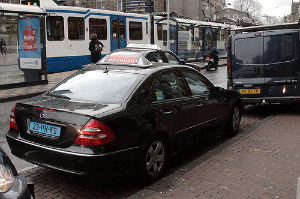 Sometimes a taxi is the right call. You can hail one on the street, but big parts of the center are no-stopping zones, so it's usually easiest to go to a taxi stand. You'll find them at Centraal Station, Rembrandtplein, Leidseplein and other busy spots. Your hotel will call one for you, and ride-hailing apps work here too.
Meter prices are capped by law. For 2026 the national maximum for a regular car (up to four passengers) is a 4.31-euro start fee, 3.17 euros per kilometer and 52 cents per minute. Vans for five to eight people can charge more. At those rates, a ride from Centraal Station to Museumplein, roughly 3 km, comes to around 20 euros, not the 12 to 14 euros this page used to quote. Tipping isn't required, though rounding up is common.
Canal boats as transport
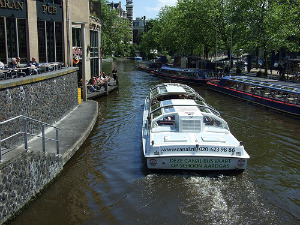 A canal cruise is a great way to see the city on your first day. The price has gone up since the days of 9-euro tours: Stromma's classic one-hour cruise, for example, starts from 13.50 euros, and smaller open boats start around 20 euros (as of 2026).
Some operators have also run hop-on, hop-off boats over the years, but as transport they're slow and expensive. Most people who try to use them to get around give up after the first lap, because walking is faster unless you happen to be going exactly where the boat is going.
>> For more on the cruises, including why they're a great option when you first arrive, see our guide to Amsterdam canal tours.
Bicycling in Amsterdam
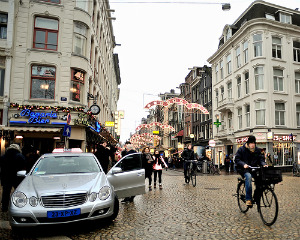 Like the canal boats, a bike looks like a great and novel way to get around, but the reality is a bit different. Renting is easy. A basic city bike at MacBike, one of the big central chains, is 17.95 euros for a day or 13.95 euros for three hours (as of 2026). But riding between museums and coffeeshops isn't as easy as it looks:
- Theft. If Amsterdam is the bicycle capital of Europe, it's also the bike-theft capital. You'll get a sturdy lock with a rental, and you should lock the frame to something fixed every time.
- Parking. Racks in the busy areas are jammed, and you can spend five minutes hunting for a spot, only to end up a couple hundred meters from where you were going anyway. Bikes left outside the racks can be removed, and the city charges 100 euros to get them back.
- Traffic. Locals ride fast, in packs, and expect you to know the rules: stay right, signal with your hand, don't stop in the lane, and give way to trams.
Don't misunderstand, a day on a rented bike can be one of the best things you do here, especially along the quieter canals or out through Vondelpark. It's just not the easiest way to get from A to B on a short visit.
>> For more, see our guide to renting a bike in Amsterdam.
Traveling on to other European cities
Most visitors have other stops on their European trip. These guides cover the options from Amsterdam:
- Amsterdam to Berlin (or vice versa)
- Amsterdam to Bruges (or vice versa)
- Amsterdam to Brussels (or vice versa)
- Amsterdam to Copenhagen (or vice versa)
- Amsterdam to London (or vice versa)
- Amsterdam to Paris (or vice versa)
- Amsterdam to Prague (or vice versa)
- Amsterdam to Stockholm (or vice versa)
For nearby Dutch cities, see day trips from Amsterdam. If Amsterdam is one stop on a bigger trip, AirTreks, BootsnAll's sister company, has put together multi-stop and round-the-world tickets since 1987:
Fly into London, on to Amsterdam, take the train to Paris, and break the trip home with a stop in Reykjavik.
photos, top to bottom, by: dsearls, Mark & Danielle Parris, eguidetravel, NewsPhoto!